FJI correspondent Doris Toumarkine reports on a new web series with a mission to share expert knowledge about film financing.
Finance advisors Vinca Jarrett and Steven Adams are film market and conference regulars who have seen investors and producers anguish over ever-evolving complex matters of global film financing. To ease their pain, the duo are launching “Show Me the F#©king Money” (SMTFM), a cross-platform project to ease the pain.
With the focus now very much on producing the web series component, they are aiming to help film people worldwide—especially investors intent on recoupment—better understand where the money is, how it functions and what it takes to get films made and investments back. Birthing this baby over the past few years, the Boston-based Jarrett and L.A.-based Adams already have about 60 two- to 30-minute webisodes in the can. These are the fruit of interviews done with a variety of industry professionals at Cannes and Toronto.
Jarrett, a longtime finance consultant and conference executive, is president of FilmPro Finance and has consulted on dozens of film projects and film slates, both at the independent and studio level since 2002. She launched FilmPro Finance Events & Conferences in 2006 with partner Adams as president of that division and remains chair of the Bloomberg Financing Summit.
Adams is president of Alta Entertainment and a Peabody Award-winning producer who has worked on both independent and studio features. He began his career at the Paradigm Talent and Literary Agency and has an extensive background in artist management.
The two met at Cannes in 2005 through a filmmaker with whom Adams had previously worked. Adams recounts the inspiration for their partnership and the SMTFM co-venture: “As both of us had experienced so many conferences, I thought this might be something we could do ourselves.” And so their webisodes function as a kind of virtual iteration of a financing conference.
Jarrett and Adams took first steps into creating their SMTFM content by leveraging their vast connections with top-tiered film business professionals who, like them, float through the important global film tests and markets. Among those film-finance players already “canned” at markets are Cassian Elwes, Jay Cohen, lawyer Schuyler Moore and Mark Urman, names familiar to the independent film world. (Adams says these webisodes, among others, are still in the editing stage.) Available webisodes can be found at showmethefkingmoney.tv, currently at no charge.
“Right now there are six webisodes available and about two are coming up every week,” notes Adams. These were captured at the last two Cannes sessions and last fall’s Toronto Fest. Adams emphasizes that “certain conversations and participants require more time” to prepare and admits that the process of refining the webisodes “has given me a whole new level of respect for the editing process.”
As interviewers in four webisodes made available for viewing, charmers Jarrett and Adams sling a mix of softball and hardball questions but certainly prove their skill at luring subjects away for a few minutes from cocktails and deal-making. With Cannes 2014 behind them, next up this year are Toronto and the AFM.
As part of Adam’s introductory words in the webisodes viewed, he emphasizes: “We like the word ‘recoup.’” Well, f#©k yeah! But SMTFM covers other topics, including investing in film, the seven phases of funding, the investor’s team, film-funding sources and why investment in the film business is unique.
In the four webisodes sampled, some nuggets of interesting and potentially useful information emerged. One executive, Robert Aarts, who runs a Netherlands-based accounting and entertainment asset management firm, explains how his company, having found a solid niche, sets up and manages collection accounts for films so that the producers and others can focus on the production chores. The firm keeps track of the producers’ money through their CAM (Capital Asset Management) agreement. As its fee, his company, which does the collecting and dividing of the money, has a piece of the film fund’s capital.
Like some other webisode participants, Aarts shares that the independent world is growing because the studios are making fewer films and notes that wealthy people continue to be seduced by the film business. And there is a lot of capital around. His advice to investors is to really think hard about the project that’s tempting them and hire the right people (lawyers, especially) for their team. “Everything can go wrong, so go with real professionals.”
Charlene Paling, a film-finance executive with the National Bank of Canada, talks about the Canadian government’s many co-production deals and treaties with dozens of countries. There’s also the government’s tax-credit program for producers, which allows them to ask the bank for money which it will get back when they get that tax credit. Producers need to support their money requests with pre-sale contracts and distribution guarantees for the projects they’re borrowing for. Paling too has observed there’s a lot more private equity around from groups and individuals venturing back into the market. Spurring this is the fact that more independent films are successful.
Additionally, she says, the Canadian Bank also provides some gap financing for productions that come up a little short on their budgets. She too underscores the importance of great legal representation. Investors also need to be aware that when money starts flowing back to a production, it’s the banks that get paid back first.
Beijing-based Ronan Wong, an executive with China’s Galloping Horse Group (which acquired major effects house Digital Domain a few years ago), tells Adams in his SMTFM episode that his best advice for foreign producers who want to access China and attract money there is to get to know the culture and do that by coming to China, feeling the market and tasting the audience. “It’s really about knowing China and its people.”
But some softball questions (“When did you first come to Cannes?” “How did you get into the business?”) and one interview subject—a self-described “auteur” with a multitude of unfamiliar credits—don’t exactly deposit in the global film-financing knowledge bank or provide any takeaway.
But good SMTFM webisode information flows in other ways, as Jarrett and Adams have devised a clever add-on by way of short “Fun Fact” text inserts (sort of like pop-up stickies) that provide additional tidbits. Depending on a viewer’s capacity for intake, these can be either useful or distracting as they pop up while subjects are talking. At least webisodes can be paused and the shards of extra information can be e-mailed.
The idea to try to untangle the world of global film financing is a good one, especially where there’s so much cross-border business, digital impact and growth in the sheer quantity of independent films produced.
Some SMTFM spring press releases, no doubt designed to raise the project’s profile at Cannes, touted the project as “the ultimate guide to insider secrets in film finance and distribution in the global marketplace…the go-to resource guide on green-lighting films, team building and navigating the ever-changing terrain of film finance.”
It’s a tall order, but Jarrett and Adams’ plans for their project are ambitious. The team envisions SMTFM available across other platforms. Down the road, possibly in early 2015, there may be an SMTFM companion book about how to invest, raise and recoup money in film. Jarrett has been working on this and although it was what inspired Adams to realize the potential for the web series, it is not at all the focus now. “It’s too early,” says Adams, “to specify a publisher or format, e-book or otherwise.”
Right now, the SMTFM webisodes have their full attention. Jarrett and Adams describe their mission as “simple. It’s an effort to provide insider techniques and introductions to top professionals in the film-financing field to all those with an interest in investing. The mandate is to demystify the business of film.” Emphasis is on the business, whose core is that, uh, f#©king money.
Adams concedes that there’s been a steep learning curve in getting things the way he and Jarrett envision. “We’re a work-in-progress, so there are plenty of challenges.” Marketing is part of that challenge. “Finding our audience is so critical,” he notes, “and we’ve already laid the groundwork for this by bringing on board a social-media team.” They, of course, are storming the usual suspects (Facebook, Twitter, Instagram) on behalf of SMTFM.
Besides marketing, arguably the biggest challenge Jarrett and Adams face and maybe key to making the project a must-visit destination is getting so much material well-organized. The consumers are out there, as the film business is awash with people needing money and those with money who are willing to gamble. And for so many, film inexorably remains a sexy and irresistible corner of entertainment they want to be a part of.
Choices abound in ways for them to organize (by kind of investment, investor, film, problems needed solutions, country, or stage where project finds itself in need of money, etc.). SMTFM is according some valuable raw material and good assets, but investment-minded consumers/viewers need an easy way in to so much information.
Says Adams, “There will be lots of organization, as we’re taking this challenge very seriously. So when we hit a certain critical mass of content, we’ll organize on multiple fronts. With lots of content, multiple categories will become more obvious. We’ll be organizing from A to Z, but right now we’re at an early phase.”
Adams also understands the complexity and unpredictability of the business. “Things are forever changing and tomorrow is history.” Beyond the usual costs, productions can hit many brick walls and soft shoulders where further investment is required (overruns, P&A, delays, etc.) and this reality must be addressed. Maybe SMTFM will one day come to the rescue.
As Adams and Jarrett build SMTFM, Adams says he’s been enjoying the ride on the learning curve. “What’s struck me is the interconnectedness of everything and the acceleration of change in the business as it tries to keep pace with the digital age. I’m also learning the extent of digital’s impact and not just the fact that it’s practically killed home entertainment the way we knew it. I go into film markets and I realize that not everyone is at all ready for what’s happening.”
Adams has also been impressed with how the incentives game that lures and rewards filmmakers—whether offered by states or countries—is becoming more competitive. He’s hoping California will up their game but says the overall competition is very good for filmmakers.
Adams also has an idea of what investors and filmmakers need most to learn. “One of the things we emphasize, and I hear it constantly, is that film is the only business people enter with a lot of dreams and so little planning.”
For now, Jarrett and Adams are having a ball going to the markets that count and schmoozing in front of the camera with so many players in the money game. As a producer, Adams says, “I love Cannes,” and the webisodes suggest that he shares this love of tests and markets with Jarrett, who also conducts some of the SMTFM interviews.
The real work lies ahead: nailing the organization, refining the webisodes, filling the pipeline by attracting more top-tier players in the finance world to share their insights, getting the word out via social media and otherwise, creating a successful marketing campaign that makes the brand stick and resonate. In other words, establishing SMTFM’s reputation as a must-visit and revisit tool for wise investing and recoupment in an increasingly exciting but challenging business.
Adams says he and Jarrett are well aware of all this and are roaring forward accordingly. If they get it right, “everyone wins.” Well, f#©k, yeah!
Thursday, June 12, 2014

Monday, June 9, 2014
‘Stars’ shines over weekend b.o.
The Fault in Our Stars had a successful, if front-loaded, opening weekend, easily besting Disney’s Maleficent and fellow new release Edge of Tomorrow. Stars scored $48 million to earn the first-place slot at the box office. The film enjoyed one of the most successful bows for a romance in years, besting past hit The Vow, which opened to $41.2 million in 2012. It did fall several million shy of the opening-weekend gross managed by lead Shailene Woodley’s last film, Divergent ($54 million), but, given the blockbuster production of that YA actioner, the comparison is not altogether fair. Stars is nothing less than a win for Fox.

As expected, the movie’s audience was overwhelmingly female (82 percent) and young (79 percent under 25). The rabid fanbase for TFIOS the book turned out in droves for a special pre-screening event, The Night Before Our Stars, on Thursday, as well as for the official opening night on Friday. In fact, Friday ticket sales accounted for an incredible $26 million of the movie’s total weekend gross. Business dropped 52 percent on Saturday, which makes the opening-weekend performance of The Fault in Our Stars one of the most front-loaded of all time. Although viewers liked the film, awarding it an “A” CinemaScore grade, such a precipitous drop its second day in theatres portends a series of steep drop-offs in the weeks ahead. Many pundits see a final tally around $100 million or so.
Holdover Maleficent continued to weave a spell over crowds and their wallets. The movie held well its second weekend in theatres, dropping 52 percent to earn $33.5 million. The live-action reimagining of the “Sleeping Beauty” fairytale has so far grossed $127.4 million, and should leave theatres with roughly $200 million to its name.

In third place, Tom Cruise vehicle Edge of Tomorrow couldn’t spin critical acclaim into b.o. gold, earning an OK $29.1 million. That’s a far cry from Cruise’s last alien-creature feature Oblivion, which opened to over $37 million. Perceived similarities to Oblivion may be partly to blame for Tomorrow’s lackluster performance – that, and the steady dip in popularity the Cruise Movie Star brand has suffered in recent years. International audiences, however, have yet to abandon Cruise. They helped make Tomorrow a worldwide success: The film earned $82 million overseas.
X-Men: Days of Future Past and A Million Ways to Die in the West rounded out the weekend’s top 5, with the former grossing $14.7 million (its total currently stands at $189.1 million) and the latter raking in $7.2 million, a 57 percent drop from last week. At this point, prospects for the Seth MacFarlane comedy look dim – the movie probably won’t make it to or past $50 million.
As expected, the movie’s audience was overwhelmingly female (82 percent) and young (79 percent under 25). The rabid fanbase for TFIOS the book turned out in droves for a special pre-screening event, The Night Before Our Stars, on Thursday, as well as for the official opening night on Friday. In fact, Friday ticket sales accounted for an incredible $26 million of the movie’s total weekend gross. Business dropped 52 percent on Saturday, which makes the opening-weekend performance of The Fault in Our Stars one of the most front-loaded of all time. Although viewers liked the film, awarding it an “A” CinemaScore grade, such a precipitous drop its second day in theatres portends a series of steep drop-offs in the weeks ahead. Many pundits see a final tally around $100 million or so.
Holdover Maleficent continued to weave a spell over crowds and their wallets. The movie held well its second weekend in theatres, dropping 52 percent to earn $33.5 million. The live-action reimagining of the “Sleeping Beauty” fairytale has so far grossed $127.4 million, and should leave theatres with roughly $200 million to its name.
In third place, Tom Cruise vehicle Edge of Tomorrow couldn’t spin critical acclaim into b.o. gold, earning an OK $29.1 million. That’s a far cry from Cruise’s last alien-creature feature Oblivion, which opened to over $37 million. Perceived similarities to Oblivion may be partly to blame for Tomorrow’s lackluster performance – that, and the steady dip in popularity the Cruise Movie Star brand has suffered in recent years. International audiences, however, have yet to abandon Cruise. They helped make Tomorrow a worldwide success: The film earned $82 million overseas.
X-Men: Days of Future Past and A Million Ways to Die in the West rounded out the weekend’s top 5, with the former grossing $14.7 million (its total currently stands at $189.1 million) and the latter raking in $7.2 million, a 57 percent drop from last week. At this point, prospects for the Seth MacFarlane comedy look dim – the movie probably won’t make it to or past $50 million.
Friday, June 6, 2014
Open Roads showcases new Italian cinema
 |
| Pierfrancesco Diliberto and Cristiana Capotondi in "The Mafia Only Kills in Summer" |
Starting June 5, Open Roads: New Italian Cinema returns to the Film Society of Lincoln Center for its 14th edition. The sixteen films in the series include dramas, comedies, and this year a strong emphasis on documentaries.
The festival was organized by the Film Society of Lincoln Center, in partnership with Istituto Luce-Cinecittà, and with the support of the Italian Cultural Institute of New York, the Italian Trade Commission, Casa Italiana Zerilli-Marimò and ACP Group. Pointing to last year's Best Foreign Film Oscar win for The Great Beauty, Roberto Cicutto, CEO of Istituto Luce-Cinecittà, notes, “Italian cinema is once again at its peak."
Among the highlights in the series is Gianfranco Rosi’s Sacro GRA, an examination of a 44-mile highway that encircles Rome. It became the first documentary to win the Golden Lion award for Best Film at the Venice Film Festival. (It was the first year the festival allowed documentaries to compete.) Two years in the making, Rosi's movie focuses on the eccentric characters he met whose lives are intertwined with the Grande Raccordo Anulare.
Alberto Fasulo’s Tir (or "tractor trailer"), the filmmaker's first fiction feature, won the top prize at the Rome Film Festival. Known for his documentaries, Fasulo combines professional actors in scripted scenes with real-life truck drivers in actual settings to present a gritty, immersive look at the hard lives of immigrant workers.
 |
| Alessandra Mastronardi and Elio Germano in "The Fifth Wheel" |
Open Roads shows how contemporary Italian filmmakers are blurring the lines between nonfiction and narrative, leading to "the emergence of documentary as a breeding ground for some of the most exciting developments in contemporary Italian cinema," according to Film Society of Lincoln Center Director of Programming and Artistic Director of Open Roads Dennis Lim.
Director Gianni Amelio has two movies in the series. The deadpan comedy L’Intrepido (A Lonely Hero) is a showcase for actor Antonio Albanese, who plays a substitute who can fill in for everyone from a train conductor to a tailor.
Felice chi é diverso (Happy to Be Different) uses archival footage and interviews to survey attitudes towards homosexuality over the past hundred years. Especially moving is the testimony of survivors of the Fascist era, who remark with wonder how "inconceivable" it was to be gay at the time.
The fiction movies offer a mix of drama and comedy. L’Ultima Ruota del Carro (The Fifth Wheel), directed by Giovanni Veronesi, stars Elio Germano as Ernesto, a decent, upright, but not very bright youth whose efforts to forge a career are thwarted by bad advice, bad friends, and pervasive corruption.
Corruption forms the backbone of La Mafia uccide solo d’estate (The Mafia Only Kills in Summer), a coming-of-age comedy that juxtaposes Mafia massacres with the romantic yearnings of Arturo, played by writer and director Pierfrancesco Diliberto, a television star known to Italian audiences as Pif. The story is tied to real-life criminal trials in Palermo that resulted in several assassinations—and the insistence by locals that "girl trouble," and not the Mafia, is the reason for all the murders.
"Here's how crazy the Mafia world is," Diliberto said. "There's this girl, a Mafioso wants to go out with her, but her parents are divorced. And in the Mafia culture, divorce is very immoral. So they say, 'Why don't we kill her father? That way she's an orphan, and the moral problem disappears.'"
 |
| Edoardo Leo, center, in "I Can Quit Whenever I Want" |
Crime and corruption also blend together in the most audacious movie in the series, Smetto Quando Voglio (I Can Quit Whenever I Want), a fast-paced, scabrous account of Peter Zinni (Edoardo Leo), a neurobiologist in Rome whose world threatens to collapse when he loses a research grant.
Instead, Zinni and his friends—unemployed college graduates stuck in demeaning, low-paying jobs—exploit a loophole in Italian law that makes designer drugs legal until specific molecules are outlawed. It's "The Big Bang Theory" meets "Breaking Bad," with the specter of an overqualified workforce with nowhere to go dominating the story.
Director Sydney Sibilia makes a smashing debut, conducting a strong ensemble cast through increasingly desperate reversals and double-crosses and staging complicated scenes with aplomb. Filled with throwaway visual gags and doubletalk, it's the kind of movie in which the country's preeminent Latin scholars find themselves pumping gas, off the books, for an illegal alien.
Valeria Solarino felt she had a chance winning the part of Giulia when Sibilia broke up during her audition. A veteran of dramas and romantic comedies, she was delighted to act in what she called her "first funny comedy. The story came from a little news item about two street sweepers who were overheard talking about Kant and The Critique of Pure Reason. I think Sibilia made it into a very true picture of what Italy is like today."
The series continues until June 16. Catch them now, because only L’Intrepido has found an American distributor so far.
Week in review: 6/2 - 6/6
While many news items this week relayed casting developments -- with a welcome emphasis on Oscar-winner Lupita Nyong'o -- cultural shifts in or influenced by Hollywood earned several headlines of note.
According to The Hollywood Reporter, the Motion Picture Association of America has submitted a petition to the Federal Aviation Administration requesting permission to use "unmanned aircraft," or drones, for filming. Drones could make aerial shots safer to film, the body claims, and would constitute a new innovative filmmaking tool. The MPAA is seeking exemption from strict FAA regulations that stipulate a licensed pilot must be present whenever a drone is released into U.S. airspace, among other requirements.
Drone cameras may be the wave of the future, but it's the futuristic The Hunger Games that is presently roiling among Eastern waves of unrest. Protestors in Bangkok were photographed throwing up the mockingjay symbol of solidarity on Sunday, the three-fingered salute followers of Games protagonist Katniss use to identify themselves, and which, in The Hunger Games books and film adaptations, has revolutionary overtones. The activists gathered to protest the military regime that has overthrown Thailand's civilian government. Per the Reporter, those involved in the demonstration wrote on Facebook that the act of holding up one's pointer, middle and ring fingers represents "freedom, equality and brotherhood." And they say blockbusters are among the more vapid of Hollywood offerings...
"Vapid" is certainly no word for Lupita Nyong'o, who has announced her involvement in two upcoming projects. The first and more high-profile of the pair is Star Wars: Episode VII, although no details regarding her role in the film have been released yet. Nyong'o will also star in, as well as produce, an adaptation of the novel Americanah for the production company behind 12 Years a Slave, Brad Pitt's Plan B. Chimamanda Ngozi Adichie's book tells the story of a romance between two Nigerians.
So far as we know, neither Nyong'o nor her love interest will burst into song at any point in Americanah, but lovers of musical romances need not feel disheartened -- Emma Watson and Miles Teller are here to provide our collective theatrical fix. The pair of young stars will headline La La Land, a "song-and-dance" musical set in L.A.
Sounds rather old-fashioned, but possibly great, as does the rumor that Denzel Washington will star in a remake of the golden-oldie Western The Magnificent Seven.
Flipping this idea of "everything old is new again," artist Peter Stults imagines what the posters for modern films would like if the films had been released in an earlier era. What would the poster for Drive look like if it had been released in the '50's? Naturally, the film would have been directed by John Ford and starred James Dean... and Clark Gable. Why not?
We can't help but think "why not?" was the motivation behind this Vulture post that claims The Fault in Our Stars the film is better than the book. Some of their points could easily serve the opposing argument, but on the off-chance you're not The Fault in Our Starsed-out yet, some of the memes are worth a look (in particular, the last).
According to The Hollywood Reporter, the Motion Picture Association of America has submitted a petition to the Federal Aviation Administration requesting permission to use "unmanned aircraft," or drones, for filming. Drones could make aerial shots safer to film, the body claims, and would constitute a new innovative filmmaking tool. The MPAA is seeking exemption from strict FAA regulations that stipulate a licensed pilot must be present whenever a drone is released into U.S. airspace, among other requirements.
Drone cameras may be the wave of the future, but it's the futuristic The Hunger Games that is presently roiling among Eastern waves of unrest. Protestors in Bangkok were photographed throwing up the mockingjay symbol of solidarity on Sunday, the three-fingered salute followers of Games protagonist Katniss use to identify themselves, and which, in The Hunger Games books and film adaptations, has revolutionary overtones. The activists gathered to protest the military regime that has overthrown Thailand's civilian government. Per the Reporter, those involved in the demonstration wrote on Facebook that the act of holding up one's pointer, middle and ring fingers represents "freedom, equality and brotherhood." And they say blockbusters are among the more vapid of Hollywood offerings...
"Vapid" is certainly no word for Lupita Nyong'o, who has announced her involvement in two upcoming projects. The first and more high-profile of the pair is Star Wars: Episode VII, although no details regarding her role in the film have been released yet. Nyong'o will also star in, as well as produce, an adaptation of the novel Americanah for the production company behind 12 Years a Slave, Brad Pitt's Plan B. Chimamanda Ngozi Adichie's book tells the story of a romance between two Nigerians.
So far as we know, neither Nyong'o nor her love interest will burst into song at any point in Americanah, but lovers of musical romances need not feel disheartened -- Emma Watson and Miles Teller are here to provide our collective theatrical fix. The pair of young stars will headline La La Land, a "song-and-dance" musical set in L.A.
Sounds rather old-fashioned, but possibly great, as does the rumor that Denzel Washington will star in a remake of the golden-oldie Western The Magnificent Seven.
Flipping this idea of "everything old is new again," artist Peter Stults imagines what the posters for modern films would like if the films had been released in an earlier era. What would the poster for Drive look like if it had been released in the '50's? Naturally, the film would have been directed by John Ford and starred James Dean... and Clark Gable. Why not?
We can't help but think "why not?" was the motivation behind this Vulture post that claims The Fault in Our Stars the film is better than the book. Some of their points could easily serve the opposing argument, but on the off-chance you're not The Fault in Our Starsed-out yet, some of the memes are worth a look (in particular, the last).
‘The Fault in Our Stars’ (period)
The domestic box office will host a battle of the genres this weekend, as teen romance The Fault in Our Stars squares off against action flick Edge of Tomorrow. Each combatant boasts an appealing cast – Shailene Woodley and sure-to-be heartthrob Ansel Elgort headline Stars; Tom Cruise and Emily Blunt top Tomorrow – and solid reviews, with the films hovering between 80 and 90 percent fresh on Rotten Tomatoes. Each is also based on a popular novel. However, and most importantly, fans of Tomorrow’s source material All You Need is Kill are nowhere near as numerous as those that have amassed behind TFIOS the book. The latter have made the trailer for Stars the most liked preview ever on YouTube. The hectic publicity tour undertaken with these fans in mind appears to have been a success, due in no small part to the presence of author John Green, who, it’s reasonable to suppose, given his Internet popularity, was the main draw.

All told, it seems a foregone conclusion The Fault in Our Stars will earn the No. 1 spot at the weekend box office. Fox is predicting a modest $25 million, but most pundits believe the film’s draw will be much higher. Fandango has said pre-sales for Stars are the highest they've ever seen for a non-franchise (i.e. Twilight) romance. The last movie to hold this distinction, The Vow, opened to $41.2 million. It’s very likely Stars does similar or even better business, potentially giving Woodley’s hit film Divergent (which bowed to $54.6 million) a run for its opening-weekend money.

That would leave Edge of Tomorrow to open at No. 2, and last week’s success story, Maleficent, to clock in at No. 3. Although Tomorrow has won over the critics, Tom Cruise is not the b.o. draw he used to be. Tomorrow may be a likable return to form for the actor, but given the film's seemingly many similarities to Cruise’s last movie, Oblivion, audiences might not care enough to purchase tickets. Still, an opening of $30 million wouldn’t be terrible. Expect Maleficent to do similar business.
All told, it seems a foregone conclusion The Fault in Our Stars will earn the No. 1 spot at the weekend box office. Fox is predicting a modest $25 million, but most pundits believe the film’s draw will be much higher. Fandango has said pre-sales for Stars are the highest they've ever seen for a non-franchise (i.e. Twilight) romance. The last movie to hold this distinction, The Vow, opened to $41.2 million. It’s very likely Stars does similar or even better business, potentially giving Woodley’s hit film Divergent (which bowed to $54.6 million) a run for its opening-weekend money.
That would leave Edge of Tomorrow to open at No. 2, and last week’s success story, Maleficent, to clock in at No. 3. Although Tomorrow has won over the critics, Tom Cruise is not the b.o. draw he used to be. Tomorrow may be a likable return to form for the actor, but given the film's seemingly many similarities to Cruise’s last movie, Oblivion, audiences might not care enough to purchase tickets. Still, an opening of $30 million wouldn’t be terrible. Expect Maleficent to do similar business.
Thursday, June 5, 2014
'TFIOS' and the ‘saccharine shadow’ of illness
In his review of the blockbuster poised to overtake – or, more apt, flood – the box office this weekend, Slant Magazine film critic David Lee Dallas says The Fault in Our Stars does not relate what its opening voiceover assures us it will: “This is the truth. Sorry,” says protagonist Hazel Grace Lancaster (Shailene Woodley), a teen with terminal cancer.
Writes Dallas:

Dallas believes the filmmakers use wit and sarcasm to distract from what is, at heart, a mawkish story. Some of his points ring truer than others, as when he calls the “improbably named” Augustus Waters “a somewhat impossible character, too High School Musical dreamy and far too optimistic considering his history.” Even in the novel on which Stars is based, where his backstory is related in, and therefore his character is rendered with, greater depth, Augustus is Dream Boy Par Excellence for roughly two-thirds of the tale. Dallas does laud actor Ansel Elgort’s chemistry with Woodley, but the reviewer falters in extending his praise: their courtship “gives the film neurotic energy to make up for the saccharine shadow cast by their illnesses.”
The fault in this statement lies in the writer’s broad decrial of illness. If Dallas had attributed the film’s saccharine quality to the fantastic characterization of Augustus – the way it fulfills adolescent fantasies of a hot, sensitive, vulnerable boy who’s super articulate and super into the books you recommend to him – and to his being the male equivalent of a desired type a la the “manic pixie dream girl” trope, well then, I might be more liable to agree: an improbable central character can make for a centrally improbable, overwrought, story. But individual character does not enter into the following issue Dallas takes with TFIOS: Its story is saccharine because of the “shadow cast by their illnesses.”
By failing to define what, specifically, about their illnesses makes Hazel and Augustus’ story saccharine, Dallas appears to write off illness itself as saccharine. He provides examples elsewhere, as he goes on to cite moments that contribute to the film’s cloying sensibility: “The remainder of their trip abroad is full of lessons learned and grand romantic gestures, ending on a mawkish note with a misjudged semi-climactic sequence combining two very dangerous thematic elements: strangers erupting into applause, and, um, the Anne Frank House.” The latter examples are offered to support his claim of mawkishness (and are kept appropriately vague, in order to avoid spoilers), but no such evidence is given, even vaguely, to bolster “the saccharine shadow cast by their illnesses.”
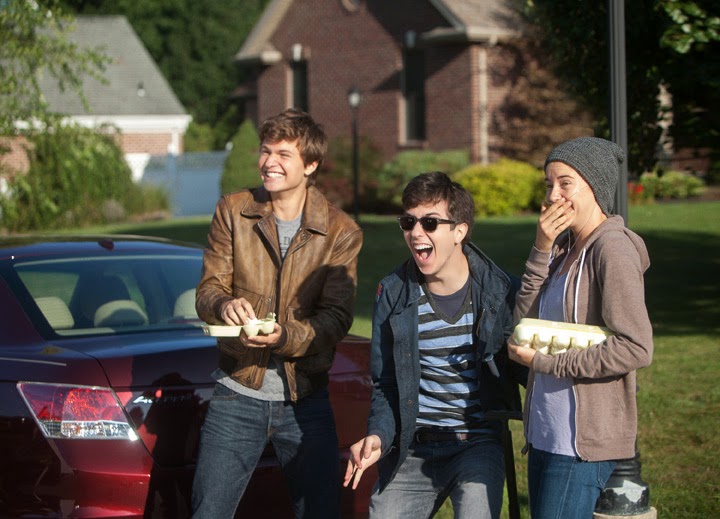
This nit-picky reading of Dallas’ review is important for the questions it raises regarding the depiction of illness. How should we talk about the ill? What kind of stories should we craft about them, for them, including them? If we put them at the center of a love story, is that love story inevitably rendered mawkish by virtue of their illness, because tragedy, in the guise of a heightened mortality, is implied and un-ignorable? In other words, can a love story about the ill, with the implied tragedy of illness ever present, ever exist free of the charge of audience manipulation?
Dallas acknowledges the filmmakers’ wish to make good on Hazel’s opening voiceover, to “stare terminal cancer baldly in the face rather than hide behind euphemisms and syrupy montages.” This was precisely the aim of John Green, author of TFIOS the novel. Green has said he wanted to write a story in which the ill are not seen as fundamentally “other.” His desire to make the ill like every (healthy) one else arguably informed his decision to endow both Augustus but especially Hazel with a hyper self-awareness, with the ability to comment on marginalization as they experienced it, their very wit and insight making marginalization out to be ridiculous. Dallas, however, feels this language, instead of serving the “noble mission” of truth-telling, obscures the truth by posing a distraction. Which, to us, poses yet another question: How should the ill be made to talk about their illness? I happen to enjoy Green’s dialogue, much of which has been ably adapted or preserved by screenwriters Michael H. Weber and Scott Neustadter, but do the fictionally ill have to show off their intelligence in order to be taken seriously? Or, to Dallas’ point, should they speak more prosaically in this effort to prove they’re just like us?

I don’t know. I know what I would like to say: “Of course it’s possible to write a love story about the ill that does not leave itself vulnerable to charges of over-sentimentality, mawkishness, audience-manipulation.” But illness is sad. It’s unfair. It’s often random, and that’s scary, and fear and sadness will make you cry. And where audiences cry, critics, of the professional or peanut-gallery persuasion, will cry over-sentimentalism. At the very least, and as Dallas himself says, those involved with The Fault in Our Stars tried to transcend poor precedents of the “euphemisms and syrupy montages” variety. Regardless of how one feels about the results, I would caution against speaking in a manner that, intentionally or otherwise, reinforces poor precedents of the sweeping generalizations variety.
Writes Dallas:
This isn’t just “a movie,” Hazel's voiceover intones over a close-up of Woodley's wonderfully expressive eyes, but a document of authentic lived experience that dares to stare terminal cancer baldly in the face rather than hide behind euphemisms and syrupy montages. A noble mission, to be sure, and one that shows the filmmakers have the right instincts about how to tell this story, but ultimately The Fault in Our Stars doesn't live up to these claims, as it takes few chances, frequently using sass as a smokescreen, hiding what's unoriginal and cheaply sentimental about this story behind a veil of witticisms about oblivion and "cancer perks."
Dallas believes the filmmakers use wit and sarcasm to distract from what is, at heart, a mawkish story. Some of his points ring truer than others, as when he calls the “improbably named” Augustus Waters “a somewhat impossible character, too High School Musical dreamy and far too optimistic considering his history.” Even in the novel on which Stars is based, where his backstory is related in, and therefore his character is rendered with, greater depth, Augustus is Dream Boy Par Excellence for roughly two-thirds of the tale. Dallas does laud actor Ansel Elgort’s chemistry with Woodley, but the reviewer falters in extending his praise: their courtship “gives the film neurotic energy to make up for the saccharine shadow cast by their illnesses.”
The fault in this statement lies in the writer’s broad decrial of illness. If Dallas had attributed the film’s saccharine quality to the fantastic characterization of Augustus – the way it fulfills adolescent fantasies of a hot, sensitive, vulnerable boy who’s super articulate and super into the books you recommend to him – and to his being the male equivalent of a desired type a la the “manic pixie dream girl” trope, well then, I might be more liable to agree: an improbable central character can make for a centrally improbable, overwrought, story. But individual character does not enter into the following issue Dallas takes with TFIOS: Its story is saccharine because of the “shadow cast by their illnesses.”
By failing to define what, specifically, about their illnesses makes Hazel and Augustus’ story saccharine, Dallas appears to write off illness itself as saccharine. He provides examples elsewhere, as he goes on to cite moments that contribute to the film’s cloying sensibility: “The remainder of their trip abroad is full of lessons learned and grand romantic gestures, ending on a mawkish note with a misjudged semi-climactic sequence combining two very dangerous thematic elements: strangers erupting into applause, and, um, the Anne Frank House.” The latter examples are offered to support his claim of mawkishness (and are kept appropriately vague, in order to avoid spoilers), but no such evidence is given, even vaguely, to bolster “the saccharine shadow cast by their illnesses.”
This nit-picky reading of Dallas’ review is important for the questions it raises regarding the depiction of illness. How should we talk about the ill? What kind of stories should we craft about them, for them, including them? If we put them at the center of a love story, is that love story inevitably rendered mawkish by virtue of their illness, because tragedy, in the guise of a heightened mortality, is implied and un-ignorable? In other words, can a love story about the ill, with the implied tragedy of illness ever present, ever exist free of the charge of audience manipulation?
Dallas acknowledges the filmmakers’ wish to make good on Hazel’s opening voiceover, to “stare terminal cancer baldly in the face rather than hide behind euphemisms and syrupy montages.” This was precisely the aim of John Green, author of TFIOS the novel. Green has said he wanted to write a story in which the ill are not seen as fundamentally “other.” His desire to make the ill like every (healthy) one else arguably informed his decision to endow both Augustus but especially Hazel with a hyper self-awareness, with the ability to comment on marginalization as they experienced it, their very wit and insight making marginalization out to be ridiculous. Dallas, however, feels this language, instead of serving the “noble mission” of truth-telling, obscures the truth by posing a distraction. Which, to us, poses yet another question: How should the ill be made to talk about their illness? I happen to enjoy Green’s dialogue, much of which has been ably adapted or preserved by screenwriters Michael H. Weber and Scott Neustadter, but do the fictionally ill have to show off their intelligence in order to be taken seriously? Or, to Dallas’ point, should they speak more prosaically in this effort to prove they’re just like us?
I don’t know. I know what I would like to say: “Of course it’s possible to write a love story about the ill that does not leave itself vulnerable to charges of over-sentimentality, mawkishness, audience-manipulation.” But illness is sad. It’s unfair. It’s often random, and that’s scary, and fear and sadness will make you cry. And where audiences cry, critics, of the professional or peanut-gallery persuasion, will cry over-sentimentalism. At the very least, and as Dallas himself says, those involved with The Fault in Our Stars tried to transcend poor precedents of the “euphemisms and syrupy montages” variety. Regardless of how one feels about the results, I would caution against speaking in a manner that, intentionally or otherwise, reinforces poor precedents of the sweeping generalizations variety.
Monday, June 2, 2014
‘Maleficent’ reigns supreme
Despite middling reviews (52 percent on Rotten Tomatoes), Maleficent is a certified hit. The reimagining of “Sleeping Beauty” opened to a boffo $70 million this weekend, easily earning the No. 1 slot at the box office. Critics were underwhelmed by the CGI-heavy flick, but, this being star Angelina Jolie’s first time in front of the camera since 2010’s The Tourist, fan interest was high. Audiences were overwhelmingly female (60 percent), though they were more evenly split by age: half were over 25, while families accounted for 45 percent of moviegoers. They awarded the film an “A” Cinemascore grade, which tends to bode well for continued box-office success. Odds are Maleficent will wind up with $200 million or so in total.

X-Men: Days of Future Past, the weekend’s No. 2 earner, should end its theatrical run with a bit more revenue under its belt, between $220 and $230 million. The actioner took in an additional $32.6 million, a downturn of 64 percent – roughly on par with expectation – from last week. Past has so far earned $162.1 million.
Far below the X-Men, Seth MacFarlane’s comedy A Million Ways to Die in the West landed at No. 3 with a disappointing $17.1 million showing. “Disappointing” is something of an understatement; the film’s gross is roughly one-third of that which MacFarlane’s Ted earned over its opening weekend in 2012 ($54 million). The mostly male (55 percent) and older (72 percent over the age of 25) crowd gave the movie a Cinemascore grade of a “B,” which, when taken with its poor reviews (33 percent rotten on RT), means West will likely make like its title, and expire soon. Look for a total gross south of $50 million.

Rounding out the weekend’s top 5, holdover Godzilla clocked in at No. 4 with its $12.2 million gross, whle Adam Sandler comedy Blended hauled in $8.4 million, bringing its 10-day total to a soft $29.6 million.
All is not lost in the land of the broad comedy, however. Neighbors continues to perform nicely, having earned another $7.7 million this weekend. Its total now stands at $128.6 million.
X-Men: Days of Future Past, the weekend’s No. 2 earner, should end its theatrical run with a bit more revenue under its belt, between $220 and $230 million. The actioner took in an additional $32.6 million, a downturn of 64 percent – roughly on par with expectation – from last week. Past has so far earned $162.1 million.
Far below the X-Men, Seth MacFarlane’s comedy A Million Ways to Die in the West landed at No. 3 with a disappointing $17.1 million showing. “Disappointing” is something of an understatement; the film’s gross is roughly one-third of that which MacFarlane’s Ted earned over its opening weekend in 2012 ($54 million). The mostly male (55 percent) and older (72 percent over the age of 25) crowd gave the movie a Cinemascore grade of a “B,” which, when taken with its poor reviews (33 percent rotten on RT), means West will likely make like its title, and expire soon. Look for a total gross south of $50 million.
Rounding out the weekend’s top 5, holdover Godzilla clocked in at No. 4 with its $12.2 million gross, whle Adam Sandler comedy Blended hauled in $8.4 million, bringing its 10-day total to a soft $29.6 million.
All is not lost in the land of the broad comedy, however. Neighbors continues to perform nicely, having earned another $7.7 million this weekend. Its total now stands at $128.6 million.
Subscribe to:
Posts (Atom)